Monday, June 28, 2010

More Canvas

Despite the delay in posting, we have not been delayed in continued efforts to make boat improvements!  Yes, the main sail cover is complete, and turned out very well.  I will add the slits for the lazy jacks when we have them positioned.


See the contrast with the old teal colored dodger top?  We've removed the windows here, but left the top for sun and rain cover, but such a sad mix of old and new!


So, the job continues.  After an intense weekend of sewing, the new dodger top is complete and the boat looks better for it:


Peter has been busy selecting and buying a radar package, which will be installed this week.  I'll spend next weekend working on the dodger windows and side pieces, and maybe we will even go sailing!  All of this work is in preparation for taking the boat north the first week of August.  Of course we have been sailing over the last couple of weeks, despite a very rainy June here in the Northwest.


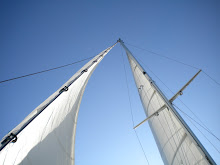
Searching for wind?  Anticipating rain?  We had a little of both this day.

Saturday, May 29, 2010

Working on New Canvas

Given our new paint job, new canvas appears to be in order.  Plus the existing canvas is worn just about beyond repair.  So the projects have begun!

First up was the tiller cover, to get get used to the new Sailrite machine and working with the heavy sunbrella fabric.  I used the existing cover (shown here) as a template.  The only challenge was the pleating to create the soft, padded end of the cover, but even with that this went very quickly.


The next project was to start on the winch covers.  I took measurements of the 7 winches, and following (more or less) the instructions from SailRite, I was able to churn out the first two.  They went pretty quickly and were not challenging to sew.  You can see the old canvas leaning against the piano in the background for color contrast.

My one lesson learned from winch cover one was not to wait until the end to insert the elastic in the internal cap - it is much easier to insert it before sewing the side seam and then attaching the circular top!


With these projects complete, it was time to tackle the main sail cover.  I ordered more fabric and materials from SailRite and studied their instructions for a standard cover.  After deliberating, I decided to copy the existing cover as I like the customized boom end piece and the fit with the buckles rather than toggles.  So on a nice day a couple of weekends ago, I laid out the cover on my fabric, traced the pattern and cut it out.

I should mention that I have been using a hot knife to cut the fabric as this seals the edges and limits the amount of seam finishing needed.  I also decided on matching thread rather than the standard white contrasting thread.  Peter and I walked the marina, looking at the covers on different boats, and I found I much preferred this look.


Sewing on this very large piece of fabric is challenging.  Our boom is about 16 feet, and I've extended the fabric at the end of the pattern to allow me room to do the custom end portion.  The existing cover is actually about 7 inches too short for some reason - I suspect it was either custom made and an error was made, or it was accidentally purchased in the wrong length.  So I will be fitting that portion on the boom to make sure it is correct.  The walking foot on the SailRite machine is wonderful - really helps when dealing with this heavy fabric.


The fitting at the mast went surprisingly smoothly - I put in some heavy nylon lining to withstand the chafing that will happen at this point.  And the zipper went in without difficulty.  I again followed an alternate method from the SailRite instructions.  Instead of sewing the zipper in from the wrong side, then turning and sewing the final seam, I did both seams from the front to make sure the two lines of stitching are parallel.  It wasn't difficult to do it this way.  I left the bottom of the zipper unfinished, as I want to finish the bottom of the cover, then lay the zipper end over that.  So with the mast fitting and zipper complete, I took it to the boat to fit the boom end.  It was fun to see it in place, and if I squint just right, I can imagine it as a finished product!  Next up - fitting the boom end.

Sunday, May 23, 2010

RCYC Middle Distance Race

Ablissian has successfully completed her first race!  We finished fourth in our class (cruising class).  What a great day - Blain, Robin and I were crew with Peter at the helm.  The start was smooth - we did not have to fight for position much and were able to get off the line cleanly.


We found that reaching with our 150% genoa we were able to stay up with many of the boats flying spinnakers.  We had light wind but were able to make way up river against the current.
As we neared the 205 bridge, we caught the top of the fleet and all spread out across the river looking for wind lanes and current relief.  Soon after, boats flying spinnakers were able to pull away and we stayed even with our NFS competition.


As we neared the mark, we all struggled to make headway against the current.  We went wing and wing, struggled with river position and found ourselves even losing ground at one point against the current.  A tactical gamble did not pay off, and our competition rounded the mark ahead of us.  While we fought to round the mark in a dying breeze, they gained ground with the current in their favor.  It was a light air drift to the finish and we were not able to catch them.

Despite frequent rain squalls, we were able to stay warm in foul weather gear, and fueled by steady chips and beverages, we finished strong.  We are all hungry for more racing; Ablissian has proved she can hold her own!


Monday, April 26, 2010

A lot has happened in the last 9 days!  At the beginning of last week the mast was re-stepped by the boat yard - when I first saw her I realized how much difference the mast makes in the overall lines of the boat.  She was starting to look like our boat again.

 My first job was to re-connect the mast wiring.  This was my job as I had done the disconnection.  I was pleased to find that my careful notes made the job pretty easy and I was finished in about half an hour.  My goal was to be sitting in the cockpit relaxing when Peter arrived, which I was.  The only issue was that despite my careful work, the instruments wouldn't function.  Peter couldn't find the issue either, so we motored back to our marina ready to tackle this the next day.  Here is a quick shot of the wiring.

After taking time to follow the wires from the initial wiring panel, though connection to the instruments, to the wiring panel at the base of the mast, we still could not find the problem.  We looked at one of the wires that appeared to be   compromised, and cut back to "fresh" wire, but that didn't correct the problem.  I wasn't sure what we could do at the point short of getting help from an expert.  Another night passed and Peter woke up with the solution.  He remembered that there is a switch on the log tracking instrument - and found that this switch controlled the current to the instruments as well.  So all is good!  (Lesson learned - often sleeping on a problem helps you find the solution).

On Wednesday my shipment arrived from Sailrite - a new heavy-duty sewing machine, and materials to start work on replacing all of the teal colored canvas with new forest green canvas.  The old canvas was literally falling apart in places, so this is much more than a cosmetic need.  I was able to knock off one winch cover and the tiller cover over the weekend.  Next up is the mainsail cover - and I need to order more material for the remaining 6 winch covers.  We have plans for a number of other small canvas projects (line bags, jib sail bag, instrument cover, etc.) but the biggest job will be making a new dodger.  I'll get myself comfortable on the machine and materials with these small jobs before I take that on, but my initial feeling is that I'll be able to do this!


After the wiring, Peter took on the task of running the lines - he had marked all channels and was able to get things re-assembled fairly easily.  He took time during the process to wash the lines, many of which were a bit green with moss, so they look much better now.  Then on Sunday morning we put the mainsail on the boom and she was a fully functional sailboat again!  We took her out for our first sail since March - it was a nice day with sun mixed with clouds; not much wind but lots of boats out for spring sailing!


Saturday, April 17, 2010

It Must be Spring!

It is a beautiful weekend in Portland.  Typical spring in the northwest, we have alternated heavy rain with warm sun, but the temperatures are in the 70's.  We started the weekend listening to a presentation on tips for crossing the Columbia River Bar, given at the Portland Yacht Club. We had a dual purpose:  of course to listen to the presentation, but also to walk the docks at the club as we expected to see a number of Cascade 36s.  The talk was really good - conducted by a man who regularly crosses the bar with his fishing boat, and supplemented by Dave, from the US Coastguard, who drives one of the Coastguard vessels at Astoria.  The talk was pretty casual, but had a number of good points and things to consider when making the crossing.  Afterward, I realized I forgot to ask my super newbie questions:  a) where is the best place to "sit" while waiting for optimal time to cross and b) how long in total does it take to cross?  So how do you know when to leave your sitting place and head out?  Any advice is welcome!

Our visit to the docks was disapointing in that we only saw one Cascade, but also good as we ran into Blain who was getting ready to head out sailing - we later saw them out on the river racing.  Interesting themes - Blain told us he felt his son kick in Robin's belly for the first time today (wow!), then as we walked up the dock we saw these adorable baby geese.  Must be spring!

Sunday, April 11, 2010

Weekend Projects

We have been investigating different products to clean and buff the deck of the boat - the gelcoat has some oxidation and is dull and a bit stained.  Over the weekend we worked on one side using a 3M cleaner/polish followed by wax - a two step system.  Peter did the initial cleaning and I followed with the wax.  It took quite a bit of effort but the results are good.  It is hard work - your arms get tired quickly.

Our other weekend project was to install the new battery remote.  The original one was defective.  Fortunately, Peter left the newly installed wiring in place and we were able to just put in a new unit.  It worked like a charm.  Kim at the Columbia Marine Exchange was great about the return/replacement.

The final project was to replace the bulbs on both mast lights - they were not burned out, but while the mast is down it makes sense to replace them.  We don't know how long they have been in place and if it means one less trip up the mast in the future, I'm in favor of that!

It was nice to spend some time on the boat, puttering about.  But we are anxious to get the mast back so we can go sailing!

No pictures of our work, so I'll simply post a couple of sailing shots from last fall to get us thinking about getting out on the water soon!


Thursday, April 8, 2010

In the Water

She is in the water (shown here at the boat yard dock).  On Monday, she was lowered and we planned to drive her to our marina, which is more sheltered than the Schooner Creek dock.  But there were storm fronts moving through with wind gusts at 30 - 40 knots, so we didn't want to risk using the braille method to get into our slip.   Although our marina is protected, and the wind effect would be minimal given our mastless state, it didn't seem wise.

But Tuesday was a calm day, so at day's end we went to the boatyard and fired her up.  I was more concerned than usual to get directions straight on how to back out from the dock, and realized that without rigging to grab ahold of, it would be a bit more challenging to climb quickly on to the boat.  But I worried for naught as Peter just backed smoothly out of the slip and I stepped aboard.  We headed up river, winding our way through the fishing boats trailing lines  on the river with the opening of the Chinook season (I think).  Without a mast to worry about, we motored carelessly under the I-5 bridge.  It was cloudy but calm.

We didn't have a depth gauge, as apparently we disrupted a link when we disconnected the mast wiring.  But the channel is clear and we knew our way into the marina.  It could not have gone more smoothly - we wound our way to G dock and Peter pivoted into our slip.  A few weeks ago we changed from using a bow line to a center line when docking, and it makes it so simple to pull the boat up to the dock and then move to the bow and stern to tie off.  I'm much more comfortable with this, although I'm still perfecting the timing on pulling her in far enough before moving off of the center.

We fussed for a while to get the lines set to minimize bumping against the dock - the paint is still in the hardening stage - connected to shore power and headed home.  Looking back as we walked down the dock, she looks like a new boat; happy in her snug slip.

Blog Archive